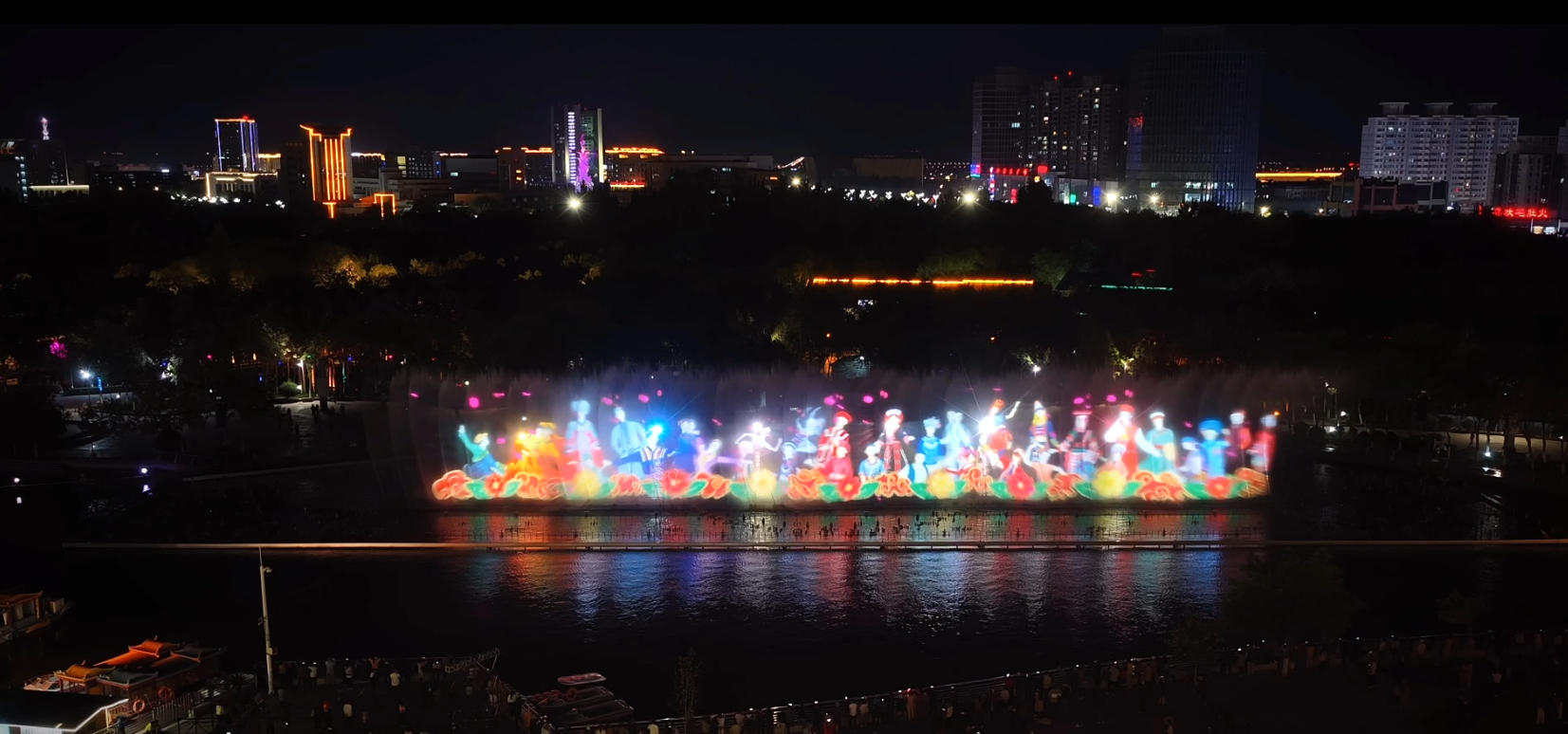
A water curtain light show — also called a water screen projection show, water curtain projection or 3D water screen show — is one of the most spectacular attractions a venue can install. A controlled sheet of falling water becomes a giant, semi-transparent projection surface, and video, animation and brand stories appear to float in mid-air.
What Is a Water Curtain Light Show?
A water curtain light show is an audiovisual display in which a precisely controlled layer of falling water acts as a temporary projection surface. High-pressure pumps push filtered water through a line of precision nozzles to form a thin, uniform water sheet — sometimes called a water curtain or water screen. A high-brightness projector then directs images onto that moving surface. Because the water sheet is partly transparent, the projected image appears to float in open space rather than sit on a solid screen.
It is not a hologram in the strict optical sense. The water itself is the screen: light from a projector is scattered and reflected by millions of tiny water droplets toward the audience. That subtle movement of the water is exactly what makes the effect feel alive, dreamlike and cinematic — characters appear to walk out of the water, fireworks dissolve into rain, and logos hover over a lake.
How Does a Water Curtain Light Show Work?
A professional system combines three disciplines: hydraulics, optics and show control.
- Water screen generation. A circulation pump sends filtered water through pipes, valves and a manifold to a nozzle bar. The nozzles atomise the water into a dense, uniform vertical sheet. Nozzle geometry, spacing, pressure and water quality all control the density and smoothness of the surface — a broken or turbulent sheet shows up as dark bands, flicker or distortion in the image.
- Projection. A high-brightness laser or LED projector is aligned to cover the exact area of the water sheet. The media server maps every element of the video to the real dimensions of the water surface. Bright highlights, saturated colours, strong silhouettes and large text perform best; fine detail and low-contrast scenes are lost on a moving, semi-transparent surface.
- Synchronisation. A show-control platform ties together the pump, projector, laser, lighting, audio and media server using timecode or DMX512. The show may open with architectural lighting, raise the water curtain, introduce a story or brand animation, and close with a coordinated water-and-laser climax.
Core Components of a Water Screen Projection System
A reliable installation is more than a projector and a hose. The main subsystems are:
- Water screen generator — high-pressure pump, nozzle bar and distribution manifold that create the uniform water sheet.
- Water treatment and circulation — filtration, reservoir or basin, overflow protection and, where appropriate, water-chemistry management.
- High-brightness projector or projector array — typically 10,000 ANSI lumens and up for outdoor shows; multiple projectors are edge-blended for very wide screens.
- Media server and playback — stores and plays the show files and maps them onto the water surface.
- Lighting and laser effects — underwater LED lighting sets the mood; laser units add beam effects and can run alongside the projection.
- Audio system — speakers, amplifiers and sound processing for the soundtrack and narration.
- Show control system — timecode/DMX synchronisation, manual override, emergency stop and remote monitoring.
- Structural platform — a fixed or floating frame, splash containment, drainage and maintenance access, built from corrosion-resistant materials.
Main Types of Water Curtain Shows
| Type | How it looks | Typical use |
|---|---|---|
| Vertical water curtain | A fan-shaped or rectangular sheet of falling water used as a projection screen | Plazas, shopping malls, building facades, stage backdrops |
| Floating lake water screen | A large screen built on a floating platform in a lake or reservoir | Theme parks, resort lakes, city waterfronts, large night shows |
| Digital (droplet) water curtain | Programmed nozzles switch on and off to draw text, numbers and shapes in falling water | Atriums, entrances, brand installations, interactive displays |
| Mist / fog screen | A fine mist layer that catches projection, often indoor or low-wind outdoor | Museums, exhibitions, brand activations, indoor events |
Where Are Water Curtain Light Shows Used?
Water curtain projection has moved from a novelty to a standard attraction for venues that want a memorable night-time experience:
- Theme parks and amusement parks — as a nightly headline show that draws crowds and extends dwell time.
- Resorts and hotels — as a repeatable evening show over a pool or lake that guests photograph and share.
- City landmarks and waterfronts — as an iconic public display that supports tourism and night-time economy.
- Shopping malls and commercial spaces — as an interior or entrance feature and as an advertising medium.
- Museums and cultural venues — for storytelling, cultural performances and interactive displays.
- Events and brand activations — for product launches, festivals, national-day celebrations and sponsored content.
Water Curtain Show vs. LED Screen vs. Hologram
Each technology has strengths. A water curtain creates a transparent, kinetic, floating image with strong emotional impact; an LED screen offers better daytime legibility and precise pixel control; holographic-style effects suit controlled indoor spaces. To compare costs, image quality, maintenance and the right fit for each venue type.
Benefits of a Water Curtain Light Show for Venues
- Unforgettable wow factor — a floating image on water is something audiences have never seen indoors.
- Built-in social sharing — guests film and post the show, giving the venue free promotion.
- Content flexibility — stories, brand messages and seasonal programmes can be updated without replacing hardware.
- Scalable size — screens can range from a few metres wide indoors to 40-metre-plus installations on lakes.
- Night-time economy driver — a show gives visitors a reason to stay, return and spend after dark.
Is a Water Curtain Light Show Right for Your Project?
Before you commit, consider four questions: Do you have a suitable site (water source, drainage, power and a safe audience viewing area)? Will the show run mostly at night (ambient light reduces contrast)? Do you have a team able to operate and maintain it? And does the budget cover the full lifecycle — design, equipment, installation, content and maintenance — not just the hardware price?
Frequently Asked Questions
What is the difference between a water curtain and a water screen?
In practice the terms are used interchangeably. A water curtain usually refers to the vertical sheet of falling water itself, while a water screen emphasises that same sheet used as a projection surface. Vendors often use “water screen” for the complete projection system.
Is a water curtain projection a hologram?
Not in the strict sense. It is a real projection surface made of moving water droplets. Because the sheet is semi-transparent, images appear to float in air, which is why the effect is often marketed as 3D or holographic — but it is light projected onto water, not a volumetric hologram.
Can a water curtain light show be used outdoors?
Yes — most installations are outdoor. The design must address wind, rain, ambient light, drainage, waterproofing (IP65 or higher for electronics), electrical protection and emergency shutdown. Wind is the main challenge because it can break the water sheet and shift the image.
How bright does the projector need to be?
At least 10,000 ANSI lumens for a professional outdoor show, and 20,000 lumens or more where ambient light is significant. The exact requirement depends on screen area, throw distance, viewing distance and operating time.
What maintenance does it require?
Nozzle inspection, filter cleaning, pump checks, reservoir cleaning, projector air-filter and lens service, cable checks and media-system backups. Water quality must be managed to prevent deposits, algae, odour and nozzle blockage.