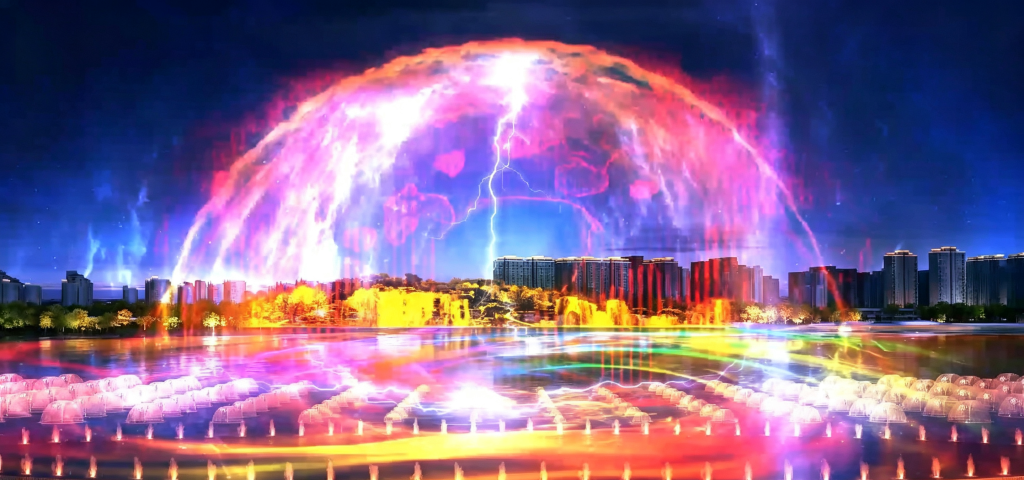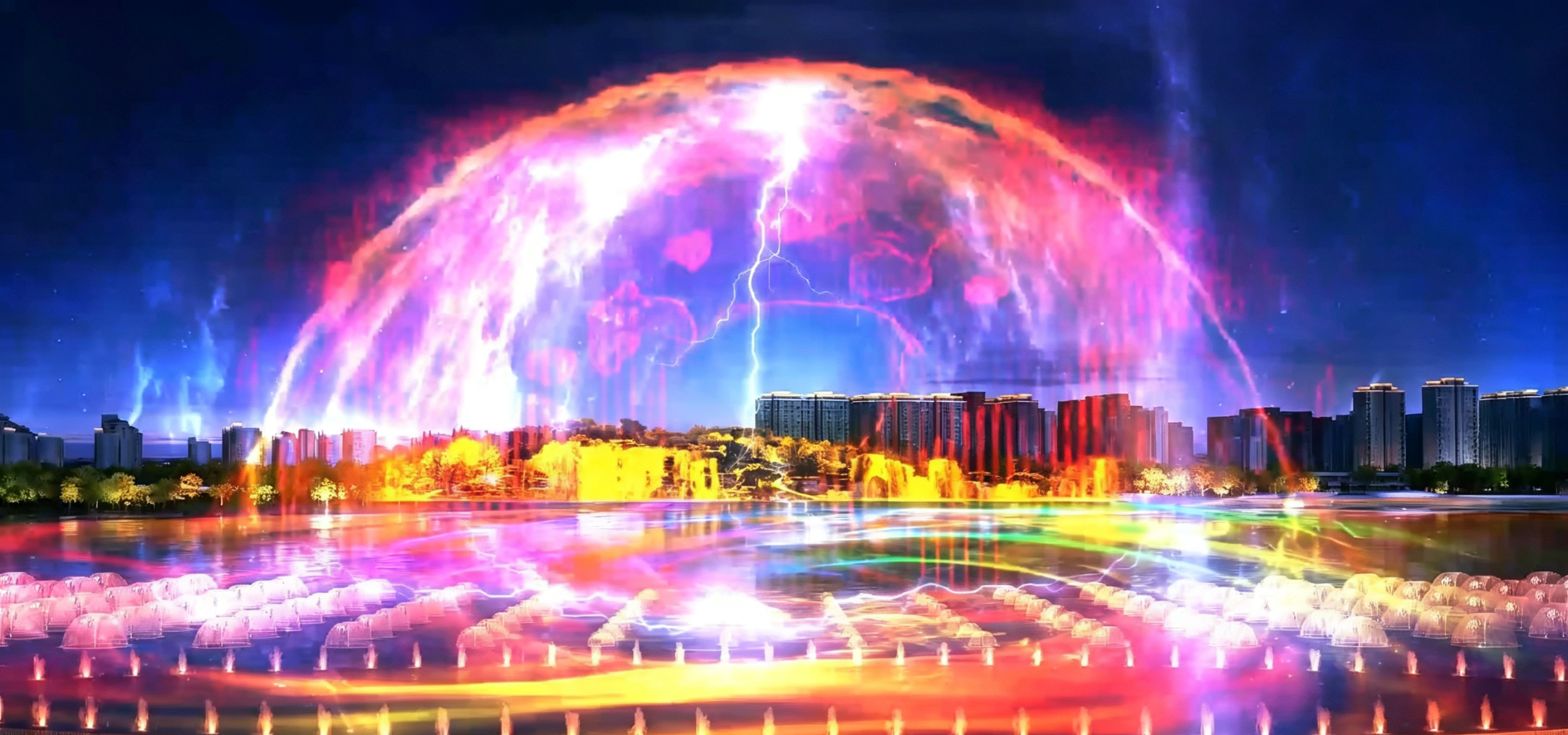
Water screen movies are immersive nighttime performance projects that combine high-pressure water screen systems, projection equipment, lighting and sound systems, control systems, and water feature art. They are commonly used in cultural and tourism attractions, urban plazas, river and lake parks, and commercial waterfront districts. Water screens are categorized into fan-shaped, rectangular, 3D, and holographic types, and can be projected onto lake surfaces, river channels, or artificial pools.
I. General Design Principles
1. Safety First: Ensure electrical waterproofing, waterfront protection, and flood and wave resistance. Keep equipment away from pedestrian areas and implement safeguards against electric shock and accidental falls into the water.
2. Site Adaptation: Determine the water screen size, viewing distance, and equipment placement based on the size of the water body, wind direction, and noise levels from surrounding buildings.
3. Primarily Nighttime Use: Suitable only for nighttime performances; the dimmer the ambient light, the better the imaging effect; avoid interference from strong streetlights or bright landscape lighting.
4. Content and Hardware Compatibility: Water curtain images have a coarser grain than ordinary screens; video content must be custom-produced and should not simply reuse standard footage.
5. Easy Operation and Maintenance: Equipment must be easy to maintain; consider winter freeze protection and water filtration to ensure suitability for long-term outdoor use.
II. Site and Scale Selection
1. Site Conditions
Preferred: Open lake surfaces or river channels with a water depth of ≥1.5–2.5 m; wind and waves should not be excessive. A windless or light breeze environment is optimal; strong winds can tear the water curtain.
Viewing Distance: The optimal viewing area is 8–15 times the height of the water curtain.
> Example: For a 15-meter-high water curtain, the optimal viewing distance is 120–220 meters.
Avoid backlighting, strong light from the shore, and reflections from buildings.
2. Detailed Selection of Common Water Curtain Specifications
Based on parameters from mainstream commercial projects on the market, this section categorizes water curtains into three types—small, medium, and large—to clarify dimensional parameters, hardware configurations, visual effects, and suitable scenarios, making the selection process clearer:
Small Water Curtain (Affordable, Mass-Market Option)
With an overall height of 6–10 meters and a screen width of 10–18 meters, this is the preferred specification for community plazas, commercial riverside districts, and small artificial landscape ponds. This type of water screen has a small footprint, low water supply energy consumption, and simple equipment deployment. It does not require large floating platforms and can be installed directly on a simple base along the shore. Only 2–3 high-brightness laser projectors are needed to meet imaging requirements, delivering a complete and smooth image with a soft, non-glaring visual effect. Ideal for close-up viewing by visitors, it is designed for daily nighttime ambiance lighting and small-scale recreational performances. With extremely low operational and maintenance costs, it is well-suited for regular, looped playback.
Medium-sized Water Screen (Mainstream Model for Cultural Tourism)
With a screen height of 12–18 m and a width of 20–35 m, this is the core choice for comprehensive urban parks, cultural tourism landmarks in districts and counties, and small-to-medium-sized river and lake scenic areas. The dimensions balance visual impact with site adaptability, offering a wide projection area capable of fully presenting rich content such as narrative animations, city promotions, and themed special effects. The hardware configuration supports a multi-projector edge-blending system, which eliminates image seams and significantly enhances image clarity. It can be integrated with basic lighting and background music for synchronized performances, delivering a rich and expressive show. Suitable for both daily illumination and small-scale festive themed performances, this is the most cost-effective and widely adopted specification.
Large Sector-Shaped Water Screen (High-End Performance Model)
With a screen height of 20–30 m and an ultra-wide screen width of 40–80 m, this is a specification exclusively designed for large-scale cultural and tourism live performances. It is suitable only for open natural lake surfaces, large riverside scenic areas, and core attractions within comprehensive tourism destinations. It features a classic fan-shaped water curtain that spreads outward, creating a thin, uniform screen surface without gaps and offering an extremely wide field of view, capable of accommodating hundreds of spectators simultaneously. The hardware must be equipped with multi-projector seamless stitching, full-color laser effects, and an intelligent synchronized fountain system. The overall visual impact is extremely powerful, supporting high-end scenarios such as immersive themed spectacles, special festival performances, and large-scale cultural and tourism exhibitions. It serves as the core project for landmark nighttime performances in scenic areas.
III. Core System Components
1. Water Screen Generation System (Main Water Feature)
1. Specialized Water Curtain Nozzles: Fan-shaped water curtain generators that form a continuous water film; water discharge must be uniform with no gaps or interruptions.
2. High-Pressure Water Supply Pump Sets: Flow rate and pressure must be matched to the water curtain dimensions; submersible pumps or shore-based centrifugal pumps are typically used in a primary-standby configuration.
3. Filtration System: River and lake water must be filtered to prevent silt and sand from clogging the nozzles; a simple water treatment system is recommended.
4. Floating Platforms/Fixed Bases
– On lakes: Floating platforms that can be repositioned as needed, facilitating maintenance.
– Along the shore: Fixed concrete bases.
5. Recirculation and Overflow: For projects in pools, implement a recirculation system; for natural rivers and lakes, allow direct discharge.
6. Frost Protection Design: In northern regions, drain pipelines during winter and insulate pump bodies to prevent freeze-cracking.