How Do Cold Mist Fountains Differ from Regular Fountains?
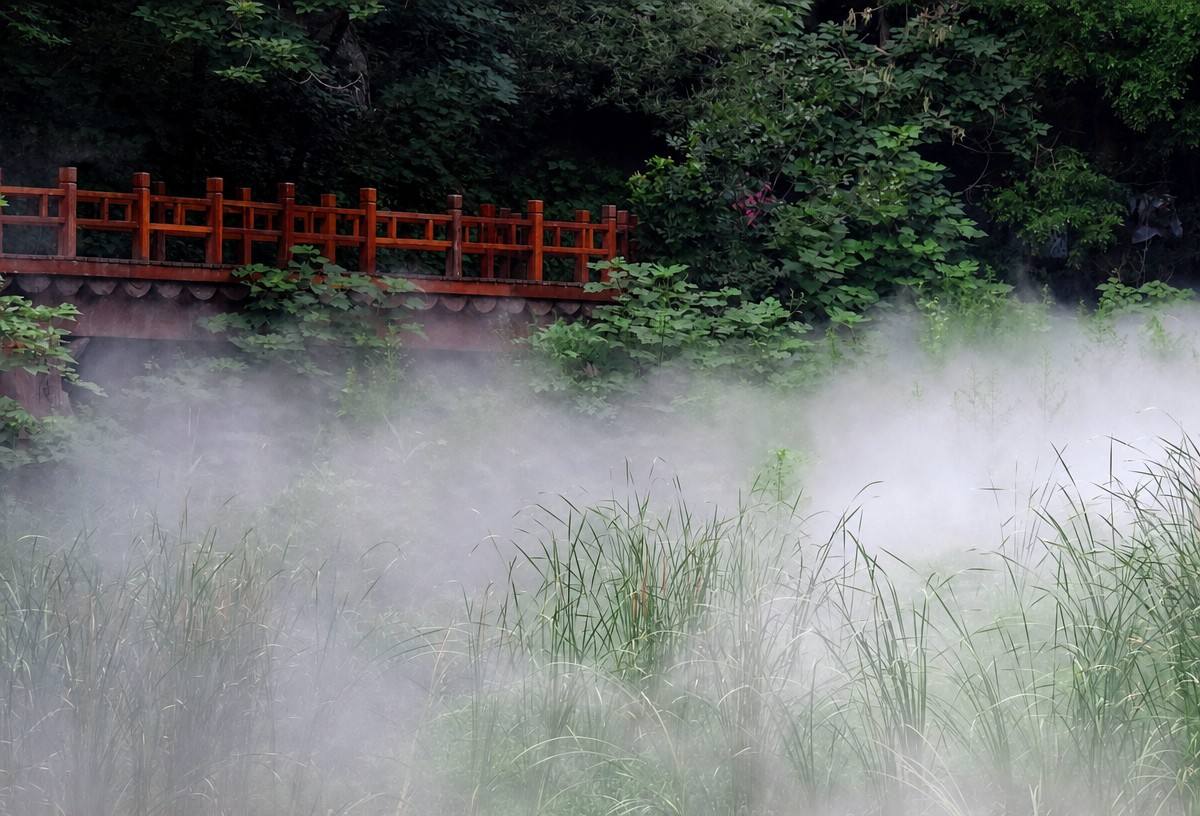
Regular fountains are all about the shape of the water jets, while cold mist fountains are all about the “mist.” Water is pressurized to 60–70 kilograms by a high-pressure pump and sprayed through micro-perforated nozzles into a fine mist of 5 to 10 micrometers. It hovers in the air like light smoke, and when the sun shines on it, it produces a Tyndall effect. It doesn’t get your clothes wet; when you walk through it, you just feel a cool breeze, which is why it’s also called “dry mist.” This is entirely different from fog projection—which uses a projector to project images onto the fog—where the fog itself is the main attraction.
Cooling Through Evaporation
The mist particles are small and evaporate quickly. Evaporation absorbs heat from the air, so as the mist disperses, the temperature drops. Field tests in summer show that it can lower temperatures in public squares by 5 to 8 degrees Celsius, with the cooling effect felt even more noticeably. Tourist attractions’ waiting areas, plaza fountains, and zoos all rely on this technique to get through the hottest days of summer.
How to Combine Fog with Fountains
Fog isn’t used on its own; it must be paired with water jets and lighting. Water jets are positioned in the center, while fog blankets the base and surrounds the area. When lights shine through, the fog captures the light, creating a three-layered effect of light beams, fog, and water jets—far more three-dimensional than a fountain viewed on its own. The mist should be directed with the wind, and the density and height of the nozzles should be adjusted according to the venue—if the mist is too thick, it becomes murky; if too thin, it has no effect.
Water Quality Is the Biggest Pitfall
Nozzle orifices are only a few tenths of a millimeter in diameter; calcium and magnesium in tap water will clog them as soon as scale forms. Water softening and filtration are standard requirements; in areas with hard water, if no treatment is applied, the nozzles will be clogged within two months, and the mist will become increasingly sparse. Pressure must also remain stable; if it drops, the mist particles become larger and settle directly as “wet mist,” soaking clothes and leaving puddles on the ground.
Suitable Settings
Squares, scenic area entrances, real estate model communities, courtyards, zoos, and botanical gardens—any location requiring both cooling and aesthetic appeal is suitable. Open, windy areas are not suitable, as the mist disperses immediately when blown; enclosed indoor spaces are also unsuitable, as rising humidity creates a stuffy atmosphere.
How Liutong Does It
Liutong’s cold mist fountain systems are designed as an integrated solution—from high-pressure units, nozzle placement, and water treatment to wind field assessments. We conduct on-site tests of mist effectiveness and cooling performance before implementation. It’s not enough for the mist to simply come out; we only consider the project complete when it effectively lowers summer temperatures without producing “wet mist.”