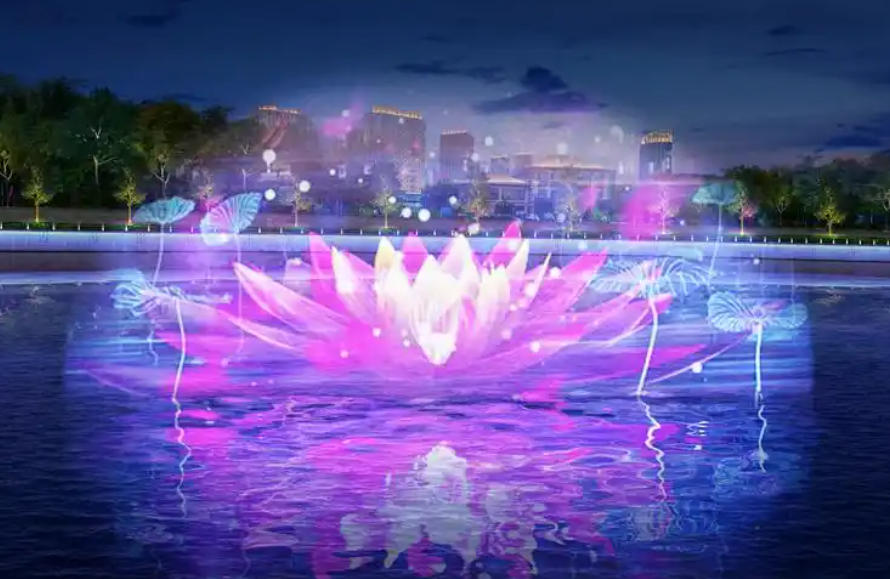
I. What Is Water Screen Light and Shadow Show Design?
A water curtain light and shadow show is a live performance that uses the water surface or water mist as a medium and the water curtain as a screen: high-pressure water pumps and an array of nozzles create a projectable water curtain, which, in sync with four systems—high-lumen projectors, lasers, lighting, and musical fountains—projects 3D animations, video footage, and brand logos directly “into the air,” creating an immersive nighttime visual spectacle.
The difference from ordinary musical fountains: Fountains rely on water shapes, while water curtain shows rely on visual storytelling—the water curtain serves as a natural, projectable screen, which is precisely why it has become a powerful tool for attracting visitors to nighttime scenic areas and urban landmarks.
II. Four Core Systems
1. Water Curtain System (“Screen”): Common types include fan-shaped, linear, and ring/circular water curtains. Over 90% of outdoor projects opt for fan-shaped water curtains due to their optimal cost-effectiveness. Key design considerations from Sohu.com: Nozzle density determines image detail, while stable water pressure ensures image clarity. Outdoor installations must incorporate wind-resistant design. (For large-scale water screens, windbreaks can be installed, or performances can be scheduled during periods of light wind.)
2. Projection System (“Projector”): Since water is a translucent medium, standard projectors lack sufficient brightness; high-lumen, outdoor-rated, waterproof laser projectors must be used. Industry standards: For outdoor nighttime shows, the measured ANSI lumens must be ≥20,000, with large-scale projects reaching up to 50,000 lumens; resolution is typically 4K; when the image is too large, multiple projectors use “edge blending” for seamless stitching.
3. Lighting and Laser System (“Atmosphere”): Underwater LED spotlights illuminate the water columns; shore-based color-changing lights create the ambiance; and lasers in the air enhance the beam effects, intertwining with the water curtain and water columns to build visual layers and climaxes, synchronized with the projection content via the DMX512 protocol.
4. Broadcast Control and Synchronization System (“Brain”): A server centrally schedules the timelines for the four systems—water curtain, projection, lighting and lasers, and audio—to achieve millisecond-level synchronization. It supports multiple program presets and emergency manual control.
III. Design Process (5 Steps)
Site Selection and Feasibility Assessment (wind direction and speed, water quality, power supply, audience flow) → Water Screen System Selection (sector-shaped / linear / circular) → Projection, Lighting, and Laser Design → Content Production (3D Modeling, 3D Mapping, Glasses-Free 3D) → Installation, Commissioning, and Rehearsal Optimization.
IV. Key Design Considerations
Water curtain dimensions are determined by viewing distance: For a typical viewing distance of 30–80 meters, the water curtain height should be no less than 6 meters to ensure the image is displayed in its entirety; Hangzhou Huayi Water Show Culture & Technology Group Co., Ltd.
Wider is not necessarily better: Excessive throw ratios result in blurred edges; projection distance and angle must be calculated based on site conditions;
Content is King: Produce themed videos incorporating local cultural IPs, ensuring the visuals align with the emotional tone of the music;
Engineering Details: Equipment must be waterproof and fog-proof; projectors must be positioned away from fountain water jets to prevent lens wetting; systems must be drained in winter to prevent freezing; equipment must be concealed and aesthetically integrated without disrupting the landscape.
V. Application Scenarios
Cultural and tourism attractions / nighttime entertainment performances (immersive light and sound shows to attract visitors), municipal squares (city landmarks), commercial complexes (to draw crowds), real estate model communities / festive events (brand展示), and can be set up on open bodies of water such as lakes, rivers, and waterfront landscape areas.
VI. Factors Affecting Pricing
Water curtain dimensions (width and height), number and brightness of projectors (costs are significantly higher for 20,000 lumens or above), laser and lighting configurations, content production complexity (3D animation / 3D mapping), and civil engineering and electrical/plumbing conditions. We recommend a comprehensive evaluation based on “visual impact + budget + operation and maintenance.”
VII. Conclusion
A successful water curtain light and shadow show is a collaborative effort combining water curtain engineering, projection technology, creative content, and synchronized broadcast control. It is recommended to select a professional team with one-stop capabilities in water curtain equipment, projection systems, content production, and construction and commissioning. Such a team can oversee the entire process—from theme planning to final acceptance—and transform the water surface into a “storytelling” screen.