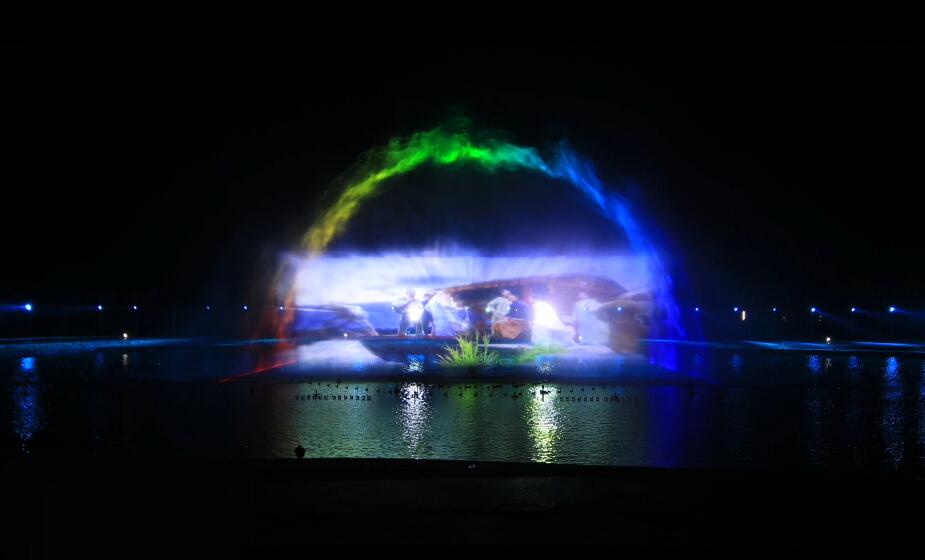
Water screen projection show design has revolutionized outdoor entertainment, brand marketing events, and cultural performances. It transforms precisely engineered falling water films into vibrant projection surfaces, delivering immersive visual effects that traditional LED walls and stage screens cannot achieve.
Whether you are planning a grand nighttime show at a theme park, a landmark performance in a city square, or a high-profile brand unveiling event, understanding the design principles behind water screen projection is essential. This guide covers the relevant technologies, equipment composition, design types, application scenarios, technical considerations, and budget factors you need to know.
1. What Is a Water Screen Projection Show?
A water screen projection show is a multimedia performance project that relies on high-pressure water pumps and specialized nozzle arrays to generate a controllable layer of falling water, which serves as a semi-transparent projection medium. High-lumen projectors cast video, animation, brand logos, and live-action footage onto the water screen, creating the visual illusion of images floating in mid-air.
Unlike fixed physical screens, water screens possess dynamic qualities. The natural flow of water gives the imagery texture and depth, and the water screen itself can appear or disappear on command. When synchronized with music, lighting, laser effects, and choreographed fountain jets, it creates a complete audio-visual spectacle.
Show scales vary widely — from a 4-meter indoor brand unveiling to a large-scale outdoor lake performance exceeding 100 meters.
2. Core Components of a Water Screen Projection System
A professional water screen projection show design comprises four interworking subsystems, all of which must be unified in design, calibration, and debugging.
2.1 Water Screen Mechanism
The water screen consists of a structural frame fitted with precision nozzle arrays, paired with high-pressure water pumps and a water circulation system.
表格
| Parameter | Specification |
|---|---|
| Water droplet size | 0.1–0.3 mm (uniformly scatters light while forming a clear projection surface) |
| Water flow per meter width | 100–150 L/min |
| Main material | Stainless steel (resists water corrosion) |
Nozzles generate laminar or fan-shaped water films.
2.2 Projection Equipment
Projector selection is the key determinant of image quality.
- Brightness requirements: Outdoor projects require 20,000–30,000+ lumens; large-scale performances use laser projectors exceeding 50,000 lumens
- Preferred types: DLP and laser projectors (high brightness, long lifespan, color stability)
- Core parameters:
- Contrast ratio — critical for achieving deep black levels on the water screen
- Resolution — mainstream WUXGA; high-end projects use 4K
- Throw ratio compatibility
- IP-rated outdoor enclosures
- Extra-large water screens: Widths exceeding 20 meters require professional media servers for multi-projector edge blending
2.3 Media Control and Synchronization System
The show control system achieves millisecond-level synchronization of video playback, projector control, pump activation, lighting triggers, audio, and special effects.
表格
| Protocol | Purpose |
|---|---|
| DMX512 | Lighting and pump control |
| Art-Net / sACN | Networked lighting |
| SMPTE timecode | Master synchronization reference |
Media servers must support advanced timeline triggering, real-time effects, multi-output image mapping, and remote monitoring. Permanent installations require redundant equipment for automatic failover.
2.4 Audio, Lighting, and Integrated Support
- Audio: Line array speakers ensure even sound coverage across large audience areas, paired with subwoofers for enhanced low-frequency impact; audio must be time-aligned with video to avoid perceptible lip-sync delay
- Lighting: Moving heads, LED wash lights, and underwater lights enhance image dimensionality; backlighting, side lighting, and underwater lighting create distinctly different visual atmospheres
3. Water Screen Projection Design Categories
The choice of water screen type depends on viewing distance, wind exposure, expected image quality, site conditions, and budget.
3.1 Fan-Shaped Water Screen
The most commonly used type for large outdoor performances. A top spray bar emits a wide fan-shaped water screen, with screen widths reaching 10–30+ meters.
- Viewing distance: HD video from 20–100 meters away
- Wind resistance: Good (high water jet velocity)
- Typical applications: Theme park lake shows, city square performances, large-scale cultural events
3.2 Vertical Water Curtain
Multiple parallel streams of water cascade down from an overhead truss, forming a see-through — even walk-through — screen surface. Compared with continuous projection imagery, it emphasizes sculptural form. When illuminated, the water curtain transforms into a luminous veil.
- Suitable content: Silhouettes, logos, and stylized imagery
- Not suitable for: High-definition video content
- Typical applications: Indoor brand unveilings, event entrances, fashion shows, stage productions
3.3 Water Mist Screen
Ultra-fine water mist particles form a three-dimensional medium suspended in the air, producing ethereal, semi-transparent imagery that emerges from and dissolves into the mist.
- Advantages: Hologram-like effects, atmospheric brand experiences; requires lower projector brightness than fan-shaped screens
- Limitations: Highly susceptible to wind; prioritized for indoor or sheltered outdoor venues
- Typical applications: Interactive installations, immersive brand experiences
3.4 Fountain Array Projection
Water screen projection combined with programmed musical fountain jets. The projection medium is not a complete water film but an array of vertical water columns, creating a textured image base.
- Characteristics: Water columns rise and fall in sync with music and projection
- Typical applications: Resort hotel pools, shopping mall atriums, city square fountains
Type Comparison at a Glance
| Water Screen Type | Application Scenarios | Wind Resistance | Image Quality |
|---|---|---|---|
| Fan-shaped water screen | Large outdoor shows, theme parks, lakes | High | Excellent |
| Vertical water curtain | Indoor events, brand unveilings, event entrances | Medium | Good (stylized imagery) |
| Water mist screen | Interactive projects, hologram effects, sheltered venues | Low | Good (ethereal atmosphere) |
| Fountain array projection | Musical fountains, resorts, city squares | Medium | Fair (textured with water columns) |
4. Step-by-Step Design Process
Step 1: Creative Concept and Feasibility Assessment
Define the creative direction, audience size, viewing angles, site constraints, and budget. Conduct on-site surveys of water supply, power supply, equipment installation points, wind conditions, and ambient light levels, then produce a feasibility report.
Step 2: System Design and Engineering Planning
Select water screen type, dimensions, and placement angle; determine projectors, pumps, nozzles, media servers, audio, and lighting configurations; produce structural calculations, hydraulic schematics, and electrical drawings; complete approval procedures for permanent projects.
Step 3: Content Production
Create storyboards, scripts, 3D animations, video, graphic assets, and soundtracks. Assets must match the native projection resolution and be optimized for water screen characteristics: enhanced contrast and color saturation. Reserve a revision and adjustment cycle after test projection.
Step 4: Equipment Manufacturing and Procurement
Fabricate structural components, nozzle arrays, and custom hardware; procure all equipment; complete factory pre-shipment inspection.
Step 5: On-Site Installation and Integration
Erect structures, plumbing and drainage pipes, pumps, nozzles, projectors, audio, lighting, and cabling; debug the show control system and equipment communication protocols. On-site construction typically takes 2–6 weeks.
Step 6: Programming and Rehearsal
Choreograph the complete show timeline to achieve full equipment integration; conduct nighttime projection tests to verify brightness, color, edge blending, and water screen uniformity; optimize content and programming — this stage must not be rushed.
Step 7: Acceptance and Delivery
Conduct a full rehearsal with a test audience; archive all parameters and maintenance procedures; train venue operations staff; deliver operation manuals, spare parts lists, and warranty documents; arrange post-opening after-sales support.
5. Major Application Venues
| Venue Type | Application Value |
|---|---|
| Theme parks | Nighttime performances extend visitor stay time and create iconic photo-worthy attractions |
| Scenic areas and cultural heritage sites | Leverage landscapes and historical sites to tell local stories and myths through water screens |
| City squares | Governments build cultural landmarks and tourist attractions |
| Resort hotels | Pool and beach water screen shows serve as premium amenities, enhancing project differentiation |
| Brand marketing events | Spectacular product launches and immersive experiential marketing drive significant social media exposure |
| Commercial shopping centers | Performances in atriums and outdoor plazas attract foot traffic and generate shareable social content |
| Festivals and sporting events | Serve as the centerpiece of gala shows, often combined with fireworks and laser effects |